"It never gets any easier. You just go faster." ---Greg Lemond
"Don't buy upgrades. Ride up grades." --- Eddy Merckx
"You drive like shit." ---The Car Whisperer

Showing posts with label oil. Show all posts

2.5.11

Looking down

Today on my ride to work I saw $4.90 for gasoline at the intersection of Clark and Berteau on Chicago's north side.

We are seeing record prices in the city now. There are those of us, such as myself, that cluck our tongues with a "told-you-so" tsk, and go about our daily lives, fuel free for the most part. Small apartments in efficient buildings shield us from extravagant energy costs, our walkable neighborhoods entitle us to a standard of living that must be experienced to see the real value...so far.

But all of us will be feeling the pinch - if not now - sooner or later at the grocery store. For sure, one way to alleviate a lot of the pain is having that room in your budget instead of losing it to direct fuel costs. But soon formerly well-fed people will be going visibly hungry, and along with the news of high fuel prices, will be the news of growing starvation among the first world.

Prices will not go down until demand does first. Supply is in fact static or even falling, and relative bump in the ratio is out of the question. This is because the trailing bell curve of production has finally caught up with discovery.

Since 1960 the population of Earth has been discovering one barrel for every four we consume. Some call it "Peak Oil Theory."

Actually, according to the International Energy Agency, and now the International Monetary Fund, it's reality.

A reality that now dictates a painful, convulsive, death spiral for our oil-addicted civilization as demand dips and rises, dips and rises, each time a little less than before, as the airlines once again become the exclusive dominion of billionaires and our standard weekend of multiple trips to Costco and Walmart are no longer affordable; until the final freefall at the end, when the big lumbering jets disappear completely from the sky and we'll walk and ride past abandoned cars and trucks rusting in the deteriorating streets.

When will we start noticing the fewer planes in the sky? The abandoned cars and trucks rusting in the streets? In ten years, who will be able to afford them? Each day, the dollar buys less and less, fuel becomes more and more expensive, because there is less and less net energy to fuel production of the goods and services that fuel our economy.

Any return to growth as pined for in the mass media is a self-delusional lie. We are headed into a new, heretofore unexperienced historical epoch of contraction. All of our economic growth was ultimately driven by the annual increases of available net energy...increases in energy production. But those increases in net energy are gone, never to return.

Says Jim Kunstler (who has been sounding the alarm on oil-dependency since the late 80s) of Clusterfuck Nation:
The "drill drill drill" gang is under the impression that North America has vast unexplored regions where oil is just begging to be discovered. This is not true. The New York Times reported after Obama's speech - in a disgracefully dumb story by Clifford Krauss - that the eastern Gulf of Mexico and Atlantic Coast contain 3.8 billion barrels of oil. Really? Hello! The US uses over 7 billion barrels of oil every year. Does the Arctic National Wildlife refuge contain between 4 and 11 billion barrels (US gov estimate)? Great, that averages out to about a year or so of US supply. And I'm not even against drilling there, only against the idea that it represents a meaningful "solution" to our problem.

Meanwhile, the old standby Alaskan oil fields at Prudhoe Bay are depleting so remorselessly that there may not be enough flow in a year or so to move the oil through the famous pipeline.

How about Canada's tar sands? Well, first of all, they belong to Canada, not us, unless we want to change that - and that could be politically messy. The tar sands will never produce more than 3 million barrels a day. The operations are already too huge, costly, and damaging to the northern watershed. Canada is our number one source of imported oil, but China would also like to buy Canadian oil. Are we planning to invoke the Monroe Doctrine to prevent Canada from selling its oil to parties outside the Western Hemisphere? That could be messy, too.

It's only when looking at the situation in the Middle East through the lens of Peak Oil does it make any sense. We are not there to "steal" oil but rather rather to ensure we keep our share when there is no longer enough to go around for all and we no longer can afford a bidding war. One can only hope the Earth's global powers retreat into isolation and accept inevitible contraction rather than continue the bidding with nuclear warheads.

Don't be the proverbial Grasshopper. Instead learn from the Ant. This doesn't mean, move to a Montana militia camp and hoard supplies; it means adopt a simpler, more self-sufficient and self-sustaining lifestyle. Replace your car with a sturdy bike. Live close to transit. Grow as much of your own food as possible, and get the rest locally.

Of course this means sacrifice!

Just because it's not what you want to hear - a new magical way to fuel all the cars and continue living in a fantasy land of limitless, nearly-free energy - doesn't mean it's not the right answer. Those who play the Grasshopper however, and hope for the slight of hand for society will discover that painfully enough.

Just ask the former residents of the once-palatial suburbs-cum-slums in Detroit, Cleveland, and a growing number of other dying American towns.

29.11.10

Food Choices

From the Newsweek article "Divided We Eat":

"This is our charity. This is my giving to the world," says Alexandra,finally, as she packs lunchboxes—organic peanut butter and jelly on grainy bread, a yogurt, and a clementine—for her two boys. "We contribute a lot."


This is not just self-congratulatory masturbation. The "savings" of cheap food, brought about by way of equal amounts of cheap oil, are in reality buck-passing. Those "savings" are borne by the public in the form of healthcare costs (11% of which treat type 2 diabetes alone), pollution, and even directly out of our pockets in the form of subsidies for those "cheap" and very empty calories.

It seems self-defeating to give to charitable public health concerns while at the same time compounding those very problems with your own lifestyle choices. Instead, spend the extra on sustainably-produced foods that have far less negative impact on public health

23.11.10

Awww, poor baby!

It is ironic, sadly and supremely so, that the group of citizens now crying and complaining over the Transportation Safety Administration’s new full-body scanners and aggressive pat-down searches are the same that drive SUVs, minivans, and cars for half-mile trips to the grocery store, to work on days when it’s “just too cold” to wait for the bus or deal with a homeless person on the train, to the gym in order to run on a treadmill, and because “I bought it, so I might as well use it.”

This is a nation so lazily and vociferously addicted to oil, believing that driving everywhere is a civil right and a way of life that they voted for George W Bush, twice, and his gigantic expansion of our already unwelcome presence in the Middle East to outright war. Not that we’d have avoided war with another president, not without changing our ways. Obama is proof of that, ineffectiveness incarnate. But by electing Bush and a propaganda machine, we convinced ourselves we could go on living as we always have, with the small inconvenience of ensuring that our Middle Eastern oil supplies aren’t endangered by Chinese or Russian intervention by intervening ourselves.

That’s the cost of “freedom,” right?

Do you really think that we’re still in Afghanistan to ensure democracy? US combat operations in Iraq may be over but our occupation is not. Do you really think that the weapons-of-mass-destruction-fiasco was just an honest error in intelligence and judgment? You are stupider than your Hummer makes you look.

Do you really think that we’re there to “steal oil?” You are stupider than your Prius makes you look.

We are awaiting the inevitable: the supply crunch. Soon there will not enough available energy at affordable prices to go around among Europe, China, Russia, and the US. It is then our Asian mission will be realized; and once it is, the terror threat will recede far into the background. If you think all parties involved will politely negotiate their way to an agreeable resolution to this shortfall, you are stupider than your protest sign makes you look.

Until then, terrorism is the most visible consequence of our oil addiction, and we bitch and moan about the TSA “abuse” with zero sense of irony. By simply reducing the amount we drive through means theoretically within our grasp we could totally eliminate our dependence on any foreign oil and any need for energy-defense missions. Most trips fewer than two miles could be made by some other mode than automobile. Why do you need so much shit from Target at one time? Why do you need such a huge truck? Can’t you drive something with better mileage? Why can’t you live in a denser area that is closer to transit?

These are all choices that you can make. However, if you have chosen to live in the suburbs and more than 2 miles from your nearest food source, voted for the candidate who cut funding for transit, or would rather drive because the bus “is for losers,” then I don’t want to hear anymore complaining about being turned into a creepy, 3D, black and white centerfold or having your genitals touched by a glorified security-guard no more qualified to be a garbage man and probably paid half as much.

We have only our own selfish behavior to blame. We're losing essential liberty for a little convenience. 300 million people changing a little can change a lot.

1.5.07

Iran Breathes a Sigh of Relief...

tThink I'm kidding? Just ask Mohammed Mosaddeq.

Ruh roh. (sorry, lazy blog today. Cleaning bikes tonight.)

Venezuela takes operations from big oil companies

Tue May 1, 2007 8:23 AM ET

By Brian Ellsworth

PUERTO PIRITU, Venezuela (Reuters) - Venezuela stripped the world's biggest oil companies of operational control over massive Orinoco Belt crude projects on Tuesday, a vital move in President Hugo Chavez's nationalization drive.

The May Day takeover came exactly a year after Bolivian President Evo Morales, a leftist ally of Chavez, startled investors by ordering troops to seize his country's gas fields, accelerating Latin America's struggle to reclaim resources.

"The importance of this is that we are taking back control of the Orinoco Belt which the president rightly calls the world's biggest crude reserve," said Marco Ojeda, an oil union leader before a planned rally to mark the transfer.

The four projects are valued at more than $30 billion and can convert about 600,000 barrels per day (bpd) of heavy, tarry crude into valuable synthetic oil.

U.S. companies ConocoPhillips, Chevron, Exxon Mobil, Britain's BP, Norway's Statoil and France's Total agreed to obey a decree to transfer operational control on Tuesday, although the OPEC nation complained ConocoPhillips was somewhat resistant.

In Puerto Piritu, near the facilities that refine Orinoco crude, workers prepared early on Tuesday to celebrate the takeovers, displaying Venezuelan red, blue and yellow flags and daubing a wall with Chavez's slogan: "Homeland, Socialism or Death."

The anti-American leader was also in a festive mood before a rally marking what he called the end of an era of U.S.-prescribed policies that opened up the largest oil reserves in the hemisphere to foreign investment.

"Open investment will never return," he said on Monday to thousands of cheering workers dressed in the signature red of his self-styled leftist revolution at a rally for workers rights.

"We are sealing up that open investment era and burying it deep down in the Orinoco oil reserve," he added.

Buoyed by an oil price bonanza in the No. 5 crude exporter to the United States, Chavez is popular among the majority poor for spending freely on schools, clinics and food handouts.

The man who calls Cuban leader Fidel Castro his mentor has vowed to take at least 60 percent of the projects, radicalizing his policies as he rules by decree and politicizes the army, state oil company and judiciary.

He is also quickly nationalizing power utilities and the country's biggest telephone company.

TOUGH TALKS

In the oil projects, the companies have agreed to hand over operations but are still discussing continued shareholding and compensation in sometimes contentious negotiations before a deadline next month.

Oil Minister Rafael Ramirez has said there may not be compensation in some cases and that Venezuela will only consider agreements on the booked value of the projects rather than their much larger current net worth.

Although Venezuela claims output of more than 3 million bpd, analysts reckon it strains to pump 2.6 million bpd. U.S. data peg it as the world's No. 8 exporter.

Industry analysts fear Venezuela's state oil company PDVSA could ultimately run into production and safety problems when it loses the management and technology of the experienced majors.

As he shrinks the private companies' role, Chavez has formed joint ventures with allies such as China, Belarus and Iran involving many state entities that are unfamiliar with developing such crude.

Still, Chavez hailed Tuesday's takeovers as the South American nation reclaiming its sovereignty.

"The wheel has turned full circle," he said. "Long live PDVSA, long live the workers of PDVSA."

23.4.07

Condition Critical

Will the real Michael Bloomberg please stand up?

Late last week, just in time for Earth Day 2007, New York City Mayor Michael Bloomberg announced his intention to impose a so-called "congestion tax" on all vehicles entering the busiest parts of Manhattan. At $8 per vehicle, the plan is closely modeled after the program that has been in place in London for quite some time.

My question, then, is why does Mayor Bloomberg continuing to persecute people at the very heart of the solution to traffic jams and pollution vexing his overcrowded island metropolis: bicyclists?

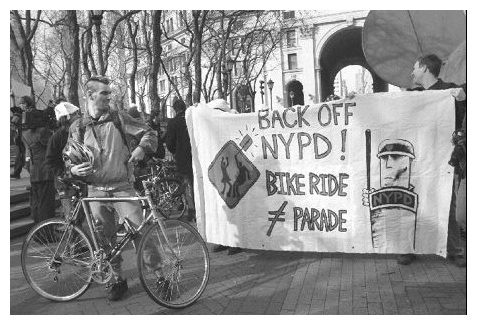
On Friday, August 27th, 2004, the New York Critical Mass ride participated in the protests of the Republican National Convention. Over 1,800 people were arrested, including over 400 cyclists, many of whom never saw their bicycles again after they were confiscated. A documentary on the night can be seen here: Still We Ride.


Since then, New York has passed or is reviewing a series of reactionary laws designed to curtail and discourage riding within the city. In addition to wasting city funds policing Critical Mass in the city (by some estimates up $1.3 million), the city has arrested nearly 500 cyclists since the 2004 protest, and around 50 or 60 cyclists are ticketed each month. Many of these tickets are deemed faulty and dismissed, yet the reaction continues. It is also illegal for more than 50 bicycles to travel in a "identifiable group" without a parade permit, and the city in considering a bill that would drop that number to 30. There is no telling what constitutes an "identifiable group". This is left up to the police department's discretion. Pedicabs will also be restricted to a total of 325 from their current number of around 450, and will also be restricted from bridge bike paths and parks.

New York's anti-cycling stance continues even as it moves towards the congestion-tax and their pledge to have America's "cleanest air" by 2030.

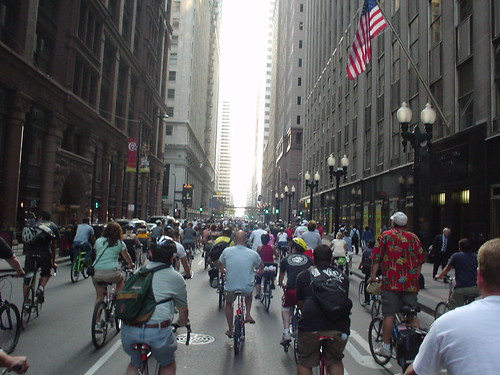
Started in 1994 in San Francisco by urban cyclists fed up with car-drivers casual dismissal of them often resulting in injury and death, Critical Mass is a forceful assertion of cyclists rights, and a mobile protest of Car-Culture. If you have ever been on a ride, or have been corked at an intersection for that matter, you certainly know it is an obnoxious and boisterous affair. In fact, it is parade-like. On any given ride expect to see freak bikes and roadies, triple tandems and recumbants, little old lady commuters and militant-communist-manifesto-bearing messengers, people dressed up as super heros or wearing suits or simply dressed in nothing at all.

The event's power, and it's weakness, lie in it's anarchy. There is no leader. Aside from various people who volunteer to run a website or own a bullhorn, the entire operation is run by consensus. The only rule is to meet the last Friday of every month at a predetermined location and ride together. Sometimes a route is voted on, sometimes the entire ride is as random as the people within it. Attendance can very from a couple dozen in the winter, to as many as 27,000, set in Yugoslavia in 2005, protesting a national election. Yet, as previously mentioned, it was too successful for it's own good that 2004 night in New York. As it had no organization, it was powerless to immediately fight the police.

The opinions on Critical Mass are wide and varied. People may, rightly, argue that Critical Mass is a selfish, bullheaded way to get a view across that bicycles are the way to go. After all, if you are convincing people that they need to ditch their cars, pissing them them off at rush hour on a Friday when they are trying to get home might not be the best way to go about it. And yes, there are the "bad apples." Those in the group who vandalize and spit on cars. The behavior that paints the entire group an awful color with a wide brush stroke.

Yet, aren't there assholes in every segment of society? There is a bigger picture, others argue, rightly. How else has any Status Quo been overturned without a fight and pissing off those who have the power? As early as 1971 in New York and elsewhere, cyclists have been crying out over needless deaths caused by nothing more than impatience and a lead foot. Motorists are most often only charged with a misdemeanor in an accident involving an injured or killed cyclist, when many times a felony of manslaughter or worse is warranted.

Car congestion and oil demand are at an all-time high worldwide. It is obvious that supply is dwindling and cannot keep up with the increasing demand. Oil-wars and diplomacy are upon us. Yet, in 2006, bicycle purchases outranked car-purchases in the United States for the first time in in 35 years. We, as a civilization, are at a critical juncture.

If you have the luck, or unluck, as your attitude may have it, to be stuck on that final Friday, corked as that boisterous bunch of bicycles blows by, think of cycling commuter's average day the other 353 days of the year. Think of the sound a revving V-8 engine makes from behind to a cyclist slowing for a yellow light (I know what you're thinking - and you haven't?). Or the sight of a car in the left turn lane, jerking back and forth, it's driver unable to make up it's mind as a cyclist, with the right of way, enters the intersection.

People like to say, "Tough shit. The roads are for cars." People who subscribe to this view point certainly wouldn't stand for the status quo continuing on any issue they're against. Car-culture, the vehicle's insulation against the outside world, it's false sense of power, and our self-entitlement blind us to the real issue. And that issue is we have constructed a society built on a model of unsustainable growth and nonrenewable resources. And a large part of society that has been speaking up about a viable solution is being marginalized, simply out of inconvenience. After all, it's far easier to drive. But the time will come when there will be no choice, inconvenient or not.

But no matter your current position on the issue. The mantra of Critical Mass should ring true for everbody. A mantra you should keep in mind the next time you are stuck in your car behind one bicycle for 20 seconds, or 27,000 for an hour. "One Less Car" equals one more parking space, one less engine spewing carbon dioxide into the air, one less demand on non-renewable resources, and one step in the right direction.